Website for a Coach or Consultant: The 5 Pages You Need
By Sam Codes · · 8 min read
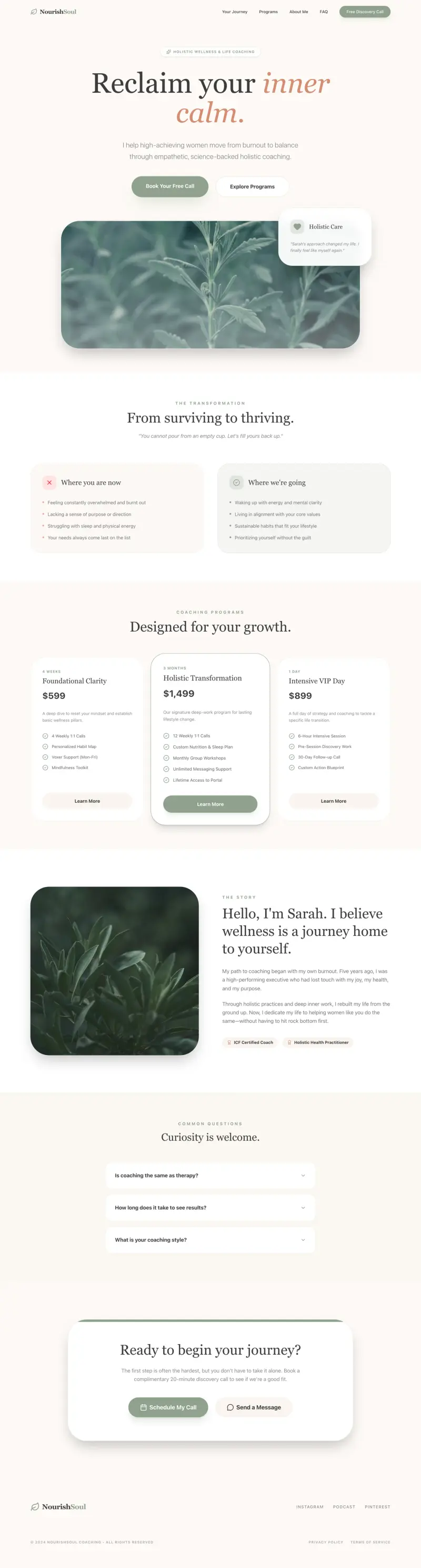
A coaching or consulting website has one job: turn a skeptical stranger into a confident lead. That means building trust fast, being clear about what you do and who it is for, and making it easy to take the next step. You do not need ten pages, a custom design, or a big budget. You need five pages built well. Here is exactly what those pages are, what belongs on each one, and how to build the whole site in a day.
What a coaching website actually needs to do
Most coaches and consultants lose potential clients not because their service is weak but because their website fails to build enough trust quickly enough. A visitor lands, cannot figure out what you do, does not see anyone like themselves in your examples, and leaves.
Your site needs to do three things in the first thirty seconds: make clear what you do and who it is for, show evidence that you can deliver the result, and give the visitor an easy next step. Five focused pages can do all of that.
Page 1: Home, the trust-builder
Your homepage is not about you. It is about your visitor and the outcome they want. The single most common mistake coaches make is leading with their credentials or their story. Lead with the result you deliver and who you deliver it for.
What to include on the home page
- A headline that names the outcome and the audience. Example: "I help first-time founders get to product-market fit without burning out." Not: "Welcome to my coaching practice."
- A one-paragraph summary of how you work and what makes your approach different.
- Two to three social proof signals up high: a recognizable client logo, a short testimonial quote, or a result ("clients typically increase revenue by X within Y months").
- A single, clear call to action above the fold. Usually: "Book a free call" or "See how I work." One CTA, not four.
- A brief bio section lower down (three to five sentences) that establishes your credibility without taking over the page.
What to leave off the home page
- Your full life story or career history (that belongs on the About page).
- Long paragraphs about your philosophy.
- Multiple competing calls to action.
- A blog feed unless it is directly relevant to what you are selling.
Page 2: Services or packages, the buying page
This page exists to answer three questions: what exactly do I get, is it right for me, and how do I start? Visitors who land here are already interested. Do not bury the answer in vague language.
What to include on the services page
- A clear name for each offer. "6-month leadership coaching program" beats "transformational partnership journey."
- Who each offer is for. A one-line sentence that names the exact person ("This is for founders at seed stage who are managing their first team").
- What the client gets: format (1:1 calls, group, async), duration, frequency, and any deliverables.
- The outcome or result they can expect, stated specifically.
- Pricing, or at least a range. Hiding price behind "enquire for details" loses clients. If pricing is genuinely custom, say "from $X" or explain why you quote individually.
- A call to action on each offer: "Book a discovery call" or "Apply now."
Tips for coaches with multiple offers
- Three offers maximum on one page. More than that and visitors cannot choose.
- Name a recommended starting point ("most clients start here") to reduce decision paralysis.
- If you have group and 1:1 options, put the higher-touch offer first.
Page 3: About, the credibility page
The About page is where someone goes after they are interested but not yet convinced. Its job is to answer: can I trust this person, and do they understand my situation? This is where your story earns its place.
What to include on the about page
- A professional photo where you look like yourself, not a stock photo version of yourself.
- Your relevant background: not every job you have ever had, just the experience that explains why you are qualified to help with this specific thing.
- The "why": a short version of why you do this work. Authentic beats polished here.
- Specific credentials, certifications, or notable clients (named with permission, or described in a way that is recognizable without naming them).
- A brief paragraph on your approach or philosophy, written in plain language.
- A secondary call to action at the bottom of the page.
Page 4: Testimonials or results, the proof page
Social proof is the most powerful trust signal on a coaching site, and it deserves its own page rather than being scattered in small doses around the site. A dedicated proof page lets skeptical visitors immerse themselves in evidence before they commit to a call.
What to include on the testimonials page
- Five to ten testimonials minimum. Under five looks thin; over twenty starts to feel like padding.
- Specific results, not vague praise. "I went from $8k to $22k months in six months" is worth ten times more than "Sam is amazing to work with."
- Photos of the people giving testimonials wherever you have permission. A face makes a quote feel real.
- Full names and, if relevant, job titles or company names.
- A mix of outcomes: transformation stories, specific results, and process testimonials ("The way Sam structures the sessions made it easy to apply immediately").
- Video testimonials if you have them, even short phone recordings, convert far better than text.
What if you are just starting out?
- Three strong testimonials from beta clients or pro-bono work beat an empty page every time.
- Case studies with outcomes (even without a named client) work well: "A founder I worked with went from zero to first paid customer in 11 weeks."
- Ask every client for a testimonial at the high point of the engagement, not at the end when they are moving on.
Page 5: Contact or booking, the conversion page
This is the page where interested visitors become leads. Friction kills conversions. Every extra field, every unclear next step, and every unanswered question about what happens after they submit loses someone.
What to include on the contact or booking page
- A calendar booking widget or a simple contact form. If you use a form, keep it to three to five fields maximum.
- A clear statement of what happens next: "I will reply within one business day" or "You will get a calendar invite for a 30-minute free call."
- A short paragraph that re-states who this call is for, so the visitor self-selects. This saves you time on unqualified calls.
- One or two reassurances: no hard sell, no obligation, what the call covers.
- Your email address as a fallback for people who prefer it.
Booking tools that work well
- Calendly (free tier covers most solo coaches) for instant scheduling.
- Cal.com (open-source alternative) for more control.
- A simple Looops contact form if you prefer to qualify leads before scheduling, it emails you directly with no third-party setup.
How to build all five pages fast
You do not need a designer or a developer to build this site. Here is the process with Looops.
Open Looops and describe your coaching or consulting business in a few sentences: what you do, who you help, your main offer, and your preferred tone. Looops builds all five pages for you, including a home page with a clear headline, a services page with your offer structure, an about section, a testimonials section, and a contact form that emails you directly.
From there you refine by chatting: "Make the headline more direct," "Add a section on my methodology," "Move the testimonials higher on the home page." Each change takes seconds, not hours. Connect your own domain and you are live the same day.
The whole build typically takes two to four hours including writing your own copy. No design skills, no code, no developer needed.
A few things that will help any coaching site
Beyond the five pages, a handful of small choices make a big difference.
- Use a custom domain. yourname.com or yourpractice.com looks professional. A free subdomain does not.
- Put your face on the site. Coaching is personal. People hire people they feel they can trust. Stock photos work against you.
- Name a specific niche. "I help first-time sales managers" converts better than "I help professionals." Specificity does not shrink your audience; it attracts the right one.
- Make your contact or booking page the CTA on every page. Do not make visitors hunt for how to reach you.
- Your site is mobile. Most visitors will see it on a phone first. Make sure it looks as good on a small screen as on a desktop.
Build your coaching website today
Describe your practice and Looops builds all five pages for you. Free to start.
Free plan available, no card required
Frequently Asked
Questions.
Keep reading
Ready to build your website?
Describe what you want and Looops builds it. Free to start, no card required.
Start building free